Thursday, March 28, 2019

Cramer Remix: Apple could decline, no matter what it announces Monday

Apple plans to reveal new products on Monday and there might not be enough to go around to satisfy everyone, CNBC's Jim Cramer said Friday.

"Apple could announce something totally mind-blowing and I bet its stock would still go down because the bears are spoiling for a fight, and after the recent run, I think that they've got the upper hand," the "Mad Money" host said.

On the agenda is the iPhone maker's much-anticipated video streaming service. Cramer said the company will need to keep making moves to bulk up the services it offers and continue building a subscriber base.

"I want them to buy Dexcom and Tandem Diabetes so they can offer diabetics a blood sugar monitor-slash-insulin pump that can be controlled from you cell phone," he said. "I like this idea better than one more video channel, but if Apple's working on a multi-media bundle I could see why that's intriguing."

Don't sweat this yield curve inversion A trader works on the floor of the New York Stock Exchange (NYSE) ahead of the opening bell, January 4, 2019 in New York City. Following a strong December jobs report, the Dow Jones Industrial Average rose 350 points at the open on Friday morning. In a television interview on Friday morning, National Economic Council Director Larry Kudlow said he believes there is 'no recession in sight.' (Photo by Drew Angerer/Getty Images) Drew Angerer | Getty Images News | Getty Images A trader works on the floor of the New York Stock Exchange (NYSE) ahead of the opening bell, January 4, 2019 in New York City. Following a strong December jobs report, the Dow Jones Industrial Average rose 350 points at the open on Friday morning. In a television interview on Friday morning, National Economic Council Director Larry Kudlow said he believes there is 'no recession in sight.' (Photo by Drew Angerer/Getty Images)

An inverted yield curve is not an automatic signal that a recession is around the corner and investors should be aware that there are bargains on the market, even if the economy is slowing down, Cramer said.

Three-month Treasury yields surpassed 10-year Treasury notes Friday and the major U.S. indexes stumbled as the S&P 500 finished its worst day since January. The Dow Jones Industrial Average, pushed by bank stocks, dropped 459 points and the S&P 500 lost 1.9 percent, and the Nasdaq Composite fell 2.5 percent during the session .

Cramer blamed the selling in large part on computer algorithms because yield curve inversions in the past have preceded recessions, most recently in 2007. But he said the machines have no way of differentiating one stock from another.

"People act like this automatically signals that we're going into a recession, but it might signal nothing more than the fact that the Fed should never have tightened in December," the "Mad Money" host said. "We're headed into another week where I think the inverted yield curve will embolden the bears ... [but] the Fed just took us one rate hike too many and now we're all paying the price."

Cramer suggested that investors "stay the course," and concerned investors should stick with stocks that have the safest dividend yields "and get ready to ride through these troubled waters."

Read his game plan for the March 25 trading week here

Assisting air traffic controllers Matt Desch, CEO of Iridium. Adam Jeffery | CNBC Matt Desch, CEO of Iridium.

Iridium Communications, the global satellite communications services provider, is gearing up to launch Aireon, a joint venture with four other air navigation companies. The new enterprise was designed to track airplanes in real time.

"They're now almost ready to launch their service to track every airplane and let air traffic controllers give more efficient service," Iridium CEO Matthew Desch said. "It's not just about safety. It's about efficiency."

Catch the interview here

Going public The Lyft Driver Hub is seen in Los Angeles, California. Lucy Nicholson | Reuters The Lyft Driver Hub is seen in Los Angeles, California.

Lyft, the ridesharing company set to hit public markets Friday, will be a good stock to buy in the short term but it has challenges in the long run, Cramer said.

"I think Lyft is exactly the kind of stock that can work in this slower growth environment, but you need to be careful with these fresh-faced IPOs," the host said. "Short term, I'm betting this turns out to be a good trade, but as a longer-term investment I'm more skeptical."

In evaluating the tech company, Cramer highlighted pros and cons about Lyft as it looks to continue taking market share in the growing transportation-as-a-service business. He predicted the company will be worth $21.5 billion and the stock could sell between 3.8 to 4.8 times next year's sales.

"I think the stock can go to $75 before it starts getting expensive relative to its peers, but for all we know it will go to $75 immediately after it starts trading. After that, I think you need to get more cautious."

More here

Get off the couch Chris Rondeau, CEO of Planet Fitness Adam Jeffery | CNBC Chris Rondeau, CEO of Planet Fitness

Planet Fitness, the "Judgement Free Zone" gym chain that caters to casual gym goers, has fine-tuned its plan to get people off the couch for the right price and the right environment, CEO Chris Rondeau said. The gym is tailored to be welcoming and comfortable for the first timers.

The stock is up nearly 25 percent in 2019 and more than 76 percent in the past year.

"We have a very streamlined business model," he said. "We don't have the pools and the daycare and the juice bars and the rock walls. We have tons of cardio, tons of circuit training equipment. So we clean, clean, clean, and pay attention to the member."

Click here for his interview with Cramer

Going public A woman browses the site of US home sharing giant Airbnb on a tablet. John MacDougall | AFP | Getty Images A woman browses the site of US home sharing giant Airbnb on a tablet.

On Thursday, a new IPO cycle was born with Levi's return to public markets. The initial share price weighed at $17 and grew as much as 30 percent during the session.

This year's anticipated lineup includes, among others, Pinterest, Airbnb, and rival ride hailing services Lyft and Uber. Other flotsam and jetsam IPOs will be sprinkled in between those launches, Cramer said.

The big funds might get overloaded and things could go "terribly awry" and "downhill," the host warned.

Cramer explains his thoughts here

Cramer's lightning round: I don't get why this stock is down so low

In Cramer's lightning round, the "Mad Money" host ran through his thoughts about callers' stock picks:

Perrigo Co.: "Why man? No, not Perrigo ... Merck. How about Merck?"

Alteryx: "You know what, no one ever got hurt taking a profit. It's a good stock. Maybe ... you take some off and let the rest run."

Codexis Inc.: "That's a small one. You know, it's a small ... tools company. You know what, let's do work on it ... We'll come back and do some homework."

Axon Enterprise Inc.: "Why is that stock down so much? I mean I gotta tell you. I think it's an absolutely great opportunity. Don't forget: Rick has got a contract ... to make money for the shareholders, and that's exactly what I want."

Disclosure: Cramer's charitable trust owns shares of Apple.

Questions for Cramer?
Call Cramer: 1-800-743-CNBC

Want to take a deep dive into Cramer's world? Hit him up!
Mad Money Twitter - Jim Cramer Twitter - Facebook - Instagram

Questions, comments, suggestions for the "Mad Money" website? madcap@cnbc.com

Tuesday, March 26, 2019

Disney-Fox merger is official, studios regroup

A whole new world officially begins today for Disney and Fox.

The Walt Disney Company's $71.3-billion acquisition of 21st Century Fox's movie and TV studios and other assets including Fox's 30 percent stake in Hulu officially closed after the clock struck midnight Wednesday morning.

Fox emerges from the deal, which Disney won in a heated bidding war with Comcast, as a streamlined company focusing on live news and sports – it maintains the Fox network, Fox News Channel and Fox Business Network, as well as sports networks FS1, FS2 and Big Ten Network, and its 28 local TV stations.

Fox Sports' 22 regional networks are in the process of being sold-off by Disney as part of the company's deal with regulators to gain approval for the merger. One network, the Yankees' YES Network, was already sold for roughly $3.5 billion to a group led by the baseball team and included Amazon and the Sinclair Broadcasting Group.

The new Disney comes out of the transaction as a box office and entertainment behemoth, with a kingdom that includes its owns studios – its live-action arm has Dumbo (March 29) and Aladdin (May 24) on the way – along with the Pixar, Lucasfilm and Marvel brands and now Fox's movie studio, which includes the Avatar, X-Men and Deadpool franchises, and FX cable network.

Actor Ryan Reynolds celebrated the deal's consummation Tuesday, tweeting a picture of the title character he portrays in the Deadpool films wearing a pair of Mickey Mouse ears on a bus headed to Disney. "Feels like the first day of 'Pool," he tweeted.

Feels like the first day of 'Pool. pic.twitter.com/QVy8fCxgqr

— Ryan Reynolds (@VancityReynolds) March 19, 2019

'Dumbo' first reactions: Tim Burton's film is beautiful, but characters are 'undercooked'

'Aladdin' near arrival: Will Smith is a rapping blue genie in new trailer

Disney dominance to hit new heights

Already commanding a lion's share of the box office, Disney will be even more dominant with Fox's studios on board. Disney owns about 30 percent of the U.S. box office and will hold about 40 percent when Fox is folded in, The Hollywood Reporter estimates. 

Powered by hits such as Black Panther, The Incredibles 2, and Avengers: Infinity War, Disney set a domestic box office record of $3 billion in 2018, according to Deadline. Add in Fox, which earned $1.227 billion, and the combined studio would have raked in $4.25 billion in the U.S. and "a massive" $10.2 billion globally, the site said.

Disney's goal is to be a dominant player not only at the box office but also on broadband. It has a Disney+ subscription streaming service scheduled to launch later this year that will be anchored by its own Disney brand, along with Pixar, Marvel, the Star Wars franchises as well as National Geographic, which it acquired in the Fox deal. 

NEWSLETTERSGet the Managing Your Money newsletter delivered to your inboxWe're sorry, but something went wrongA collection of articles to help you manage your finances like a pro.Please try again soon, or contact Customer Service at 1-800-872-0001.Delivery: FriInvalid email addressThank you! You're almost signed up for Managing Your MoneyKeep an eye out for an email to confirm your newsletter registration.More newsletters

The service will be a hit, with about 43 percent of adult broadband users saying they will likely consider subscribing (ranging from slightly to definitely likely), according to a survey of 1,949 people done in December by research firm The Diffusion Group

"This is a major studio pooling what is arguably the largest library of high-value content on the planet to populate a single branded subscription service," said The Diffusion Group president Michael Greeson in a statement accompanying the survey. 

Could merger result in reenvisioned Marvel Universe?

Fans of the Marvel Cinematic Universe are expectantly hopeful for full-on mashups involving the comic brand's hero roster, perhaps with a battle royale of the X-Men facing off against the Avengers.

Some movies will continue to be made under the Fox brand, Disney CEO Bob Iger said earlier this month, but whether that includes the X-Men and Deadpool films remains to be seen.

Marvel Studios President Kevin Feige told Variety late last year that he soon expected to get free rein to begin developing films in which Fox's Marvel characters would interact with those in Disney's Marvel films.  

"We've been told it's looking very, very good and could happen in the first six months of next year," Feige told Variety in December. "It's nice when a company that created all these characters can have access to all those characters. It's unusual not to. But in terms of actually thinking about it and actually planning things, we haven't started that yet."

The current Avengers storyline is set to culminate in next month's Avengers: Endgame (out April 26). Meanwhile, X-Men: Dark Phoenix (June 7, 2019) will flesh out the storyline of Jean Grey who develops a powerful alter ego Dark Phoenix, possibly becoming the last X-Men film released by Fox.

Fox has another X-Men film, New Mutants, scheduled for release on Aug. 2, 2019, but it remains to be seen if it sticks to that date now that the merger is complete. Originally scheduled to be released last April, the film is now rumored to head directly to Disney+. 

CLOSE

There's a new "Avengers: Endgame" trailer, and it's just as epic as you expect. USA TODAY


Follow USA TODAY reporter Mike Snider on Twitter: @MikeSnider and Eli Blumenthal @eliblumenthal

Friday, March 22, 2019

Moats, Bargains, Margins, And Patterson Companies

A few days ago, I wrote about the dental and medical distributor Henry Schein (HSIC). I included Henry Schein in my series "Preparing for the end of the cycle" as I would call Henry Schein a wide-moat company. And as Patterson Companies (PDCO) is operating basically in the same industry - both companies are operating in the dental distribution market and until the spin-off in February 2019, Henry Schein was also operating in the animal health sector - we have to question if Patterson Companies has a similar wide moat. In the following article, we will take a deeper look at Patterson Companies to find out why the company seems to be much more in trouble than Henry Schein.

Problems And Missing Moat

The business model of Patterson Companies seems very similar to Henry Schein and both are operating in the highly concentrated dental distribution market where the two companies and Banco Dental Supply together have a market share of 85%. Operating in a concentrated market often leads to higher levels of profitability and often makes it difficult for new competitors to enter the market. However, Patterson Companies seems to be missing any form of pricing power, which is common in a concentrated industry. In the following section, we are looking at different numbers and try to analyze why Patterson Companies is underperforming right now.

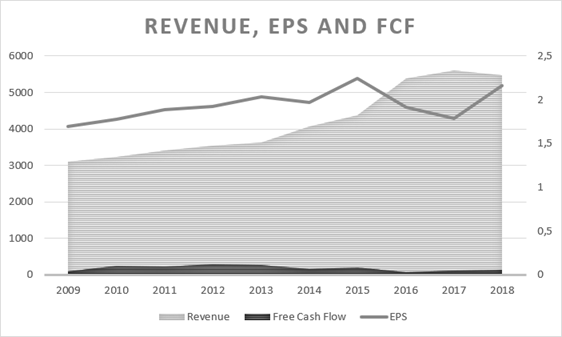
(Source: Own work based on numbers from Morningstar)

When we look at the company's revenue, we can see that Patterson Companies was able to increase revenue constantly, and only in the last three years, revenue stagnated. Over the last ten years, revenue increased by about 6.5% annually which is a very solid growth rate. The problem is earnings per share which could increase 2.8% annually but are showing a rather mixed picture (and declined in the last four quarters to a trailing 12 months EPS of $0.83). Aside from the EPS, the free cash flow is also showing a very mixed picture and declined for several consecutive years in the recent past - in 2012, free cash flow was as high as $292 million, but in 2018, FCF was only $136 million.

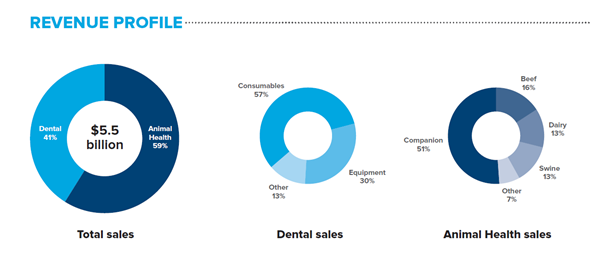
(Source: Patterson Companies Annual Report)

One problem is the fact that Patterson Companies is moving away from being a dental distributor and is focusing more on animal health. In 2018, 59% of total sales stemmed from animal health and only 41% from dental. It might be true that the animal health sector is providing growth opportunities for Patterson Companies (as the dental sector is facing some headwinds in the recent past), and in 2015, Patterson more than doubled the sales of the animal health business as a consequence of the acquisition of Animal Health International for $1.1 billion. But, in the last three years, overall revenue stagnated, and since 2016, revenue is without a clear uptrend. While revenue from animal health continued to increase in the last few years, the dental segment declined from $2,476 million in 2016 to $2,196 million in 2018.

It may be true that the animal health business is providing growth opportunities, but Patterson Companies is also moving away from the highly profitable dental business to a lower-margin business and is also jeopardizing the moat it once had. Henry Schein made the same "mistake" and moved into the animal health segment but is now focusing again on its dental business by spinning-off the animal health business unit (which is a smart move in my opinion). It is not enough to grow revenue (which also seemed to be a problem for Patterson in the last quarters), the company also has to transform revenue growth into higher earnings per share and a higher cash flow.

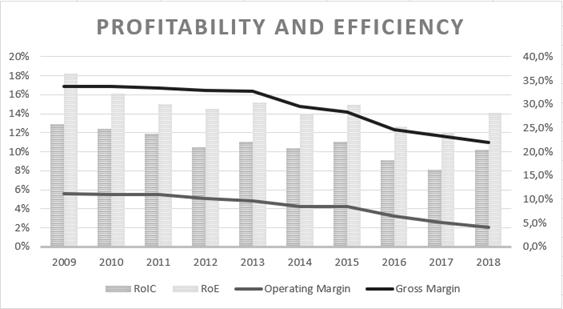
(Source: Own work based on numbers from Morningstar)

A big problem for Patterson Companies is its margins, which show a clear downward trend over the past decade. Gross margin was declining from 33.7% in 2009 to 21.9% in 2018 and operating margin was literally cut in half - from 11.2% in 2009 to 4.0% in 2018. In the last four quarters, operating margin was only 2.4%. If operating margin would decline because the company is investing heavily in research and development or in marketing and advertising, it could make sense as these efforts could lead to growth and higher profitability in the longer term. But operating expenses (as a percentage of total revenue) were decreasing in the last few years.

While the dental business generated an operating income of $229 million out of $2.2 billion in revenue, the animal health business generated only $78 million in operating income despite $3.2 billion in sales. But it is important to point out that overall operating margin is not only declining because Patterson is moving more and more into the low margin animal health business. Operating margin also declined in the high-margin dental business.

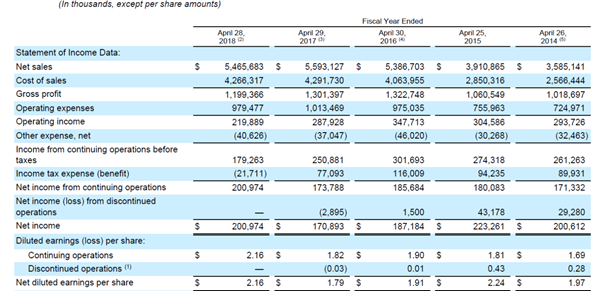
(Source: Patterson Companies 10-K)

The problem for Patterson Companies is the increasing cost of revenue. From 2014 till 2018, revenue increased from $3,585 million to $5,465 million while the cost of sales also increased from $2,566 million in 2014 to $4,266 million. Cost of revenue increased from 70.5% of sales to 78% of sales which led to a declining gross margin - from 29.5% in 2014 to 21.9% in 2018. The constantly declining gross margin is a strong hint that Patterson Companies is missing pricing power and is "buying" the higher revenue with lower profitability. Henry Schein - in comparison - could keep its gross margin very stable despite operating in similar market segments. When looking at the data of the last five quarters, it seems at least like the company could stabilize the gross margin right now and after the operating margin hit its low point in the reported numbers from July 2018, the margin could be increased again in the last two quarters.

When looking at the company's return and especially on return on invested capital, we see a ROIC which is fluctuating about 10% with an average of 9.87% over the last decade (8.08% was the low point in 2017). That's not exceptionally good, but we are certainly looking at decent numbers. A little troubling is the negative trend as the ROIC was constantly declining from 2009 till 2017, and only in 2018, Patterson Companies was able to increase ROIC once again (and might have found the bottom).

When looking at the company's balance sheet, we probably won't be excited, but there is no reason to be concerned either. Currently, the company has about $733 million in long-term debt on its balance sheet and about $22 million in short-term debt. This leads to a D/E ratio of 0.51 and when comparing the number to last year's operating income ($220 million), it would take about three and a half years to repay the outstanding debt. Both numbers are acceptable - especially as Patterson Companies has $117 million in cash and cash equivalents on its balance sheet to absorb short-term financial problems. And almost all of Patterson's debt is not due before 2022, which gives the company some time to manage the turnaround and make the company more profitable again. Additionally, the company doesn't have to be concerned with the debt levels and think about problems that could arise from high debt levels in combination with an upcoming economic cooldown (or recession).

In the recent past, Patterson Companies also changed two important positions in the management team. In November 2017, Mark Walchirk was appointed as new CEO and joined the company after being with McKesson before (as President of US Pharmaceuticals) and also spent 13 years in distribution at Baxter. In June 2018, Don Zurbay - who was working with St. Jude Medical before - joined the company as new CFO. With two new important members in the management team, Patterson Companies might have reached a turning point, and as I am certainly no supporter of short-term thinking and acting based on financial results from one single quarter, I would give the new management team a little more time before we judge if they are able to turn the company around.

Dividend

Aside from all the negative aspects about Patterson Companies that suggest the company doesn't have a wide moat, we also have to mention the dividend and the share buybacks. Currently, Patterson Companies is paying a quarterly dividend of $0.26 which is resulting in a dividend yield of almost 5%. Since 2010 - when the company started paying a dividend - it could increase the annual payments every single year, but in the recent past, dividend growth slowed down a little and for the last eight quarters, the company could keep the dividend only stable. When taking the earnings per share from 2018, the payout ratio is about 40% which seems to be an acceptable ratio. But when we take the trailing EPS of the last twelve months, we get an EPS of only $0.83 and a payout ratio above 100% which cannot be sustainable.

Additionally, Patterson Companies could bring the number of outstanding shares down from 119 million in 2010 to 93 million right now. The dividend, as well as the share buyback programs, is showing that the company obviously is generating enough cash to distribute a larger portion of it to its investors. These are positive aspects, but certainly not enough to assume that the company has a wide moat. Especially, as we have to be cautious if the dividend is sustainable. I don't think that Patterson Companies has to cut the dividend right away (the expected adjusted earnings per share for 2019 are $1.40), but I wouldn't bet on a stable dividend either. For a dividend investor, Patterson Companies could be a good pick as it has a high dividend yield, but considering aspects like dividend growth and stability of dividend, there might be better companies in the market.

Good Investment?

Patterson Companies has lost its moat in the last few years, but missing levels of defensibility against competitors doesn't automatically mean that the stock is a bad investment. And it definitely doesn't mean one can't generate high returns by investing in these companies. The decisive problem for long-term investors is the much higher levels of uncertainty and while it is impossible to know the prospective free cash flows for any company, a wide moat and high levels of defensibility add at least some predictability for future cash flows. Without a wide moat and defensibility against competitors, a company might also perform excellently over several years (and grow at extremely high rates), but it also could change very quickly.

Increasing profitability and growing margins are a possible scenario for Patterson Companies, but right now, investors have to deal with high levels of uncertainty surrounding the company as well as the fact that Patterson Companies probably lost its moat and will have to accept lower margins (and probably also missing pricing power). Although the company might be able to surprise with high growth rates in the years to come, we have no facts to support that hypothesis and should, therefore, not use high growth rates for our intrinsic value calculation.

As Patterson Companies' free cash flow is showing no clear trend, I will use the average free cash flow of the last decade ($180.7 million) as basis for my calculation. Considering all the aspects mentioned above, I will use 3% as growth rate for the next few years and also for perpetuity. This leads to an intrinsic value of $27.65 for Patterson Companies (10% discount rate) and is only allowing one conclusion: the stock is undervalued. The numbers I used for my calculation might also be too conservative and Patterson Companies could surprise despite the missing moat.

Conclusion

When looking at the different numbers and facts presented above, Patterson Companies seems to have lost its economic moat it once had. Patterson Companies is operating in a concentrated market and is a dominant player, but the declining margins (especially gross margin) show that the company obviously has no pricing power. And while the company is still able to decrease the number of outstanding shares and is paying a rather high dividend, free cash flow is showing that management has problems to generate similar amounts of FCF as in the years before. While ROIC is still solid, the number also declined constantly during the last decade (with 2018 being an exception). And although the animal health business might provide long-term growth opportunities, companies also have to be able to defend the market share against new competitors because otherwise, companies will enter those sectors that provide high levels of growth.

Nevertheless, Patterson Companies seems to be undervalued right now and could be a good pick for an investor - especially for dividend investors. Aside from the dividend, which is an aspect that speaks for Patterson Companies, Henry Schein would probably be the better company to invest in. Henry Schein is also facing price pressures and is confronted with a challenging dental market right now. But Henry Schein seems to handle the troubles much better than Patterson Companies, which is indicating that Henry Schein is having a competitive advantage while Patterson Companies probably weakened the wide moat it once had.

Disclosure: I/we have no positions in any stocks mentioned, and no plans to initiate any positions within the next 72 hours. I wrote this article myself, and it expresses my own opinions. I am not receiving compensation for it (other than from Seeking Alpha). I have no business relationship with any company whose stock is mentioned in this article.

Tuesday, March 19, 2019

Bioscrip Inc (BIOS) Q4 2018 Earnings Conference Call Transcript

Logo of jester cap with thought bubble.

Image source: The Motley Fool.

Bioscrip Inc  (NASDAQ:BIOS)Q4 2018 Earnings Conference CallMarch 15, 2019, 9:00 a.m. ET

Contents: Prepared Remarks Questions and Answers Call Participants Prepared Remarks:

Operator

Greetings and welcome to the Bioscrip and Option Care Merger Transaction call. At this time all participants are in a listen-only mode. A question-and-answer session will follow the formal presentation. (Operator Instructions) As a reminder, this conference is being recorded.

I would now like to turn the call over to Kathryn Stalmack, Senior Vice President and General Counsel for Bioscrip. Please go ahead.

Kathryn M. Stalmack -- Senior Vice President and General Counsel

Good morning, and thank you for joining us today. Earlier this morning, Bioscrip jointly announced a definitive merger agreement with Option Care, and announced the Company's fourth quarter and full year 2018 financial results.

Copies of both press releases along with an investor presentation summering highlights of the definitive merger agreement with Option Care can be found in the Investor Relations section of our website at www.bioscrip.com.

Within two hours of this call's completion, an audio replay will also be available in the Investor Relations section of Bioscrip's website. Please note that today's presentation is neither an offering of securities nor solicitation of a proxy vote. The information discussed today is qualified in its entirety by the registration statement and joint proxy statement, that Bioscrip and Option Care will be filing with the SEC in the future.

Before I get started, I'd like to remind everyone that our comments may contain forward-looking statements within the meaning of the Private Securities Litigation Reform Act. Such forward-looking statements are based on current expectations, and there could be no assurance that the results contemplated in these statements will be realized.

Please refer to our press releases, our reports filed with the SEC, where you will find factors that could cause actual results to differ materially from these forward-looking statements. These forward-looking statements are based upon information available to Bioscrip today and the Company assumes no obligation to update statements as circumstances change.

During this presentation, we will refer to adjusted EBITDA, a non-GAAP financial measure. Reconciliation to the most comparable GAAP-financial measure is contained in our press release issued this morning.

Now with me here today, President and chief executive officer, Dan Greenleaf of Bioscrip, who will begin the call with opening remarks about the transaction announced this morning. And then Steve Deitsch, Senior Vice President, Chief Financial Officer and Treasurer of Bioscrip, will provide a brief recap of Bioscrip's fourth quarter and full year financial results.

Then John Rademacher, Chief Executive Officer of Option Care and Mike Shapiro, Chief Financial Officer of Option Care will provide their remarks on the transaction, and we will leave enough time for Q&A.

All four members of the management will be available to answer your questions. And now I'd like to turn the call over to Dan Greenleaf. Dan?

Daniel E. Greenleaf -- President & Chief Executive Officer

Yeah. Hey, thanks, Kathryn, and good morning, everyone and thank you for joining us. I want to draw your attention to slide four. Clearly, it is a very exciting day for all of us. We are absolutely thrilled to have entered into definitive merger agreement with Option Care. This historic transaction will transform each of our respective companies in the entire home infusion industry through their creation of a leading independent provider of home and alternate site infusion services.

Our companies have complementary footprints and the combination creates a well diversified organization with national reach, including approximately 150 locations in 46 states. It also expands our therapies and preferred partnerships with payers, hospital systems, drug and drug manufacturers, allowing us to better serve our patients.

We operate in a highly fragmented market and this transaction gives the combined Company, the capability to serve more patients with cost effective care throughout the US. The highly complementary nature of our respective portfolios will enable the delivery of high quality, cost effective solutions to providers across the country and will position us to provide superior outcomes for patients, payers and providers.

I see a great cultural fit between our two organizations, highlighted by our common emphasis on clinical expertise and successful patient outcomes. Together, we will have more than 2,900 skilled clinicians in a footprint that covers 96% of the US population.

By merging with Option Care, we have the potential to drive significant value for Bioscrip shareholders, through a combined operating model and the realization of clearly identified synergies, along with the refinancing of Bioscrip's complicated capital structure.

Among the key financial takeaways, the combined Company is projected to deliver 2018 pro forma annual revenue of more than $2.6 billion, annual run rate cost synergies of at least $60 million within two years. Pro forma adjusted 2018 EBITDA exceeding $200 million, including synergies, a pro forma debt to EBITDA leverage ratio of approximately 6 times, providing greater flexibility for the Company to grow.

With a simplified capital structure, multiple growth opportunities and achievable run rate cost synergies, the combined Company should be able to deliver -- delever, excuse me, while pursuing a balanced capital allocation strategy, which will include market making the appropriate investments to achieve sustainable growth and shareholder value appreciation.

As one of the largest providers of home and alternate site infusion solutions in the United States, the combined Companies will be a pure play of scale. We believe it will offer investors a compelling way to participate in the attractive and growing home and alternate site infusion market.

Option Care's CEO John Rademacher will become the CEO of the combined Companies, and Option Care's, Chief Financial Officer, Mike Shapiro will become the CFO of the combined Companies.

John and Mike are accomplished healthcare professionals with significant healthcare leadership experience. I will be staying with the Company as an advisor to combined Companies' Board of Directors.

John has held various executive level positions at leading public healthcare companies, including Cardinal Health, where he served as President and General Manager for both the ambulatory care division and the nuclear and pharmacy services division. And at Cigna Corporation, where he served as President of CareAllies and Chief Operating Officer for the CIGNA Behavioral Health business.

Mike served as a Senior Vice President and Chief Financial Officer for Catamaran Corporation. A publicly traded pharmacy benefits manager and led a successful process through which the company was sold to United Healthcare Group. He also had

a long-standing career with Baxter International, holding several financial positions across several business and corporate functions. Having to got to know John and Mike better, the last several months, I'm highly confident that in working with them together, we will take the combined Company to the next level.

In short this is a great fit. We are joining two strong high-performing companies with track records of growth and success. From this position of strength, the two companies coming together are positioned to grow at even a greater rate.

I am now pleased to turn the floor over to Steve Deitsch, Chief Financial Officer, who will provide an overview of our fourth quarter and full year 2018 results. Steve?

Steve Deitsch -- Senior Vice President Chief Financial Officer & Treasurer

Thank you, Dan, and good morning, everyone. I am also very excited about this transformative and historic transaction we announced with Option Care this morning. Before we discuss the transaction further, I will provide a brief overview of BioScrip's fourth quarter and full year 2018 financial results, which were released this morning.

Fourth quarter net revenue grew 7.8% on a comparable basis to the fourth quarter of 2017. During the fourth quarter of 2018, the Company recorded a bad debt adjustment of $7.5 million based upon trends in cash collections. The bad debt adjustment reduced net revenue and adjusted EBITDA by $7.5 million.

Adjusted EBITDA was $11.6 million or $19.2 million before the bad debt adjustment compared to $17.1 million in the prior year quarter, an approximate 12% increase.

Cash and cash equivalents were $14.5 million at December 31st, 2018. Adjusted EBITDA for the full year was $45.1 million or $52.6 million before the bad debt adjustment compared to $45 million in the prior year, a 16.8% increase. This amount was slightly below the low end of our full-year EBITDA guidance, due to slower than anticipated revenue growth in December.

However, we commenced 2019 on a very strong note with gross revenue growth accelerating to 9% in both January and February, and March gross revenue to date trending at similar levels. The first quarter of 2019 will mark the third consecutive quarter of organic revenue growth achieved by BioScrip.

Finally, given the combination announced today with Option Care, the Company will not be providing updated 2019 BioScrip financial guidance.

I'll now turn the call over to John Rademacher to give you some visibility into the Option Care business. John?

John C. Rademacher -- Chief Executive Officer

Good morning, everyone, and thanks for joining us today. I'm happy to be here with you to tell you about -- more about the incredible opportunity we see through the combination of BioScrip and Option Care. And thank you Dan and Steve. I've enjoyed getting to know both of you and I look forward to working with you as we move toward closing an integration.

I want to underscore how excited I am to be bringing together two strong mission-driven companies to create a leading independent provider of home and alternate site infusion services with national reach, comprehensive therapy offering, continued independent and financial capacity and flexibility to succeed and capitalize on growth opportunities.

Taking a step back, Option Care formally Walgreens Infusion Services has been an independent infusion services company, since it was separated from Walgreens Boots Alliance in 2015 in a joint investment partnership between Madison Dearborn Partners, a leading private-equity firm based in Chicago and Walgreens Boots Alliance, Inc.

Option Care has nearly -- has a nearly 40-year history of shaping the home infusion services industry, and during our time under private ownership, we have transformed the company, benefiting from the agility of being an independent company with additional investment and access to the expertise, capabilities and resources of Madison Dearborn and a continued collaboration with Walgreens.

We have enhanced capabilities, a network of over 70 pharmacies and over 90 alternate treatment sites across the country. Over 750 payer relationships inclu

Monday, March 18, 2019

EXACT Sciences (EXAS) Shares Up 6.4%

EXACT Sciences Co. (NASDAQ:EXAS) shares shot up 6.4% during mid-day trading on Monday . The company traded as high as $91.32 and last traded at $90.85. 2,469,509 shares were traded during mid-day trading, an increase of 32% from the average session volume of 1,869,766 shares. The stock had previously closed at $85.37.

A number of brokerages have issued reports on EXAS. Zacks Investment Research downgraded EXACT Sciences from a “hold” rating to a “sell” rating in a report on Monday. Goldman Sachs Group raised EXACT Sciences from a “neutral” rating to a “buy” rating and boosted their price target for the company from $85.00 to $120.00 in a report on Tuesday, February 26th. UBS Group set a $109.00 price target on EXACT Sciences and gave the company a “buy” rating in a report on Friday, February 22nd. BidaskClub downgraded EXACT Sciences from a “buy” rating to a “hold” rating in a report on Saturday, February 23rd. Finally, Craig Hallum set a $95.00 price target on EXACT Sciences and gave the company a “buy” rating in a report on Friday, February 22nd. One equities research analyst has rated the stock with a sell rating, two have assigned a hold rating, eleven have given a buy rating and one has given a strong buy rating to the company. EXACT Sciences has a consensus rating of “Buy” and a consensus price target of $99.64.

Get EXACT Sciences alerts:

The company has a quick ratio of 11.72, a current ratio of 12.08 and a debt-to-equity ratio of 0.94. The company has a market capitalization of $11.92 billion, a price-to-earnings ratio of -69.70 and a beta of 1.83.

EXACT Sciences (NASDAQ:EXAS) last announced its earnings results on Thursday, February 21st. The medical research company reported ($0.44) earnings per share for the quarter, topping the Thomson Reuters’ consensus estimate of ($0.49) by $0.05. The business had revenue of $142.98 million during the quarter, compared to the consensus estimate of $143.00 million. EXACT Sciences had a negative return on equity of 23.29% and a negative net margin of 38.54%. The business’s quarterly revenue was up 63.6% on a year-over-year basis. During the same period in the prior year, the company posted ($0.18) EPS. Research analysts predict that EXACT Sciences Co. will post -1.85 EPS for the current year.

In related news, insider D Scott Coward sold 1,581 shares of the business’s stock in a transaction that occurred on Thursday, January 3rd. The stock was sold at an average price of $62.75, for a total transaction of $99,207.75. Following the completion of the sale, the insider now directly owns 80,544 shares in the company, valued at $5,054,136. The sale was disclosed in a document filed with the Securities & Exchange Commission, which can be accessed through the SEC website. Also, SVP Scott C. Johnson sold 1,166 shares of the business’s stock in a transaction that occurred on Thursday, February 28th. The stock was sold at an average price of $93.20, for a total value of $108,671.20. The disclosure for this sale can be found here. Over the last ninety days, insiders have sold 445,896 shares of company stock valued at $36,518,057. Corporate insiders own 3.20% of the company’s stock.

Institutional investors and hedge funds have recently modified their holdings of the stock. Cerity Partners LLC purchased a new stake in shares of EXACT Sciences during the fourth quarter worth approximately $260,000. Lisanti Capital Growth LLC purchased a new stake in shares of EXACT Sciences during the fourth quarter worth approximately $720,000. Vanguard Group Inc. increased its position in shares of EXACT Sciences by 2.6% during the third quarter. Vanguard Group Inc. now owns 10,498,087 shares of the medical research company’s stock worth $828,509,000 after purchasing an additional 261,239 shares in the last quarter. Meeder Asset Management Inc. increased its position in shares of EXACT Sciences by 602.9% during the fourth quarter. Meeder Asset Management Inc. now owns 2,910 shares of the medical research company’s stock worth $184,000 after purchasing an additional 2,496 shares in the last quarter. Finally, Biondo Investment Advisors LLC increased its position in shares of EXACT Sciences by 37.6% during the third quarter. Biondo Investment Advisors LLC now owns 153,710 shares of the medical research company’s stock worth $12,131,000 after purchasing an additional 41,965 shares in the last quarter. Hedge funds and other institutional investors own 89.37% of the company’s stock.

TRADEMARK VIOLATION NOTICE: This story was published by Ticker Report and is the sole property of of Ticker Report. If you are viewing this story on another domain, it was illegally copied and reposted in violation of United States and international copyright and trademark laws. The original version of this story can be accessed at https://www.tickerreport.com/banking-finance/4219308/exact-sciences-exas-shares-up-6-4.html.

EXACT Sciences Company Profile (NASDAQ:EXAS)

Exact Sciences Corporation, a molecular diagnostics company, focuses on developing products for the early detection and prevention of various cancers in the United States. The company offers Cologuard, a non-invasive stool-based DNA screening test for the early detection of colorectal cancer and pre-cancer.

Read More: What is a short straddle?

Saturday, March 16, 2019

Adobe Earnings: ADBE Stock Dips Despite Revenue Surging 25%

Adobe (NASDAQ:ADBE) reported its quarterly earnings results after hours Thursday, bringing in revenue and earnings that increased year-over-year, but an outlook that failed to live up to expectations was key in ADBE stock sliding a bit.

Adobe EarningsAdobe EarningsThe software developer, based out of San Jose, Calif., reported first-quarter earnings of $1.36 per share, or $1.71 per share on an adjusted basis, gaining roughly 10% when compared to the year-ago period. Analysts were calling for the company’s first three months of its fiscal 2019 to yield adjusted earnings of $1.62 per share.


Adobe added that its revenue for the period amounted to $2.5 billion, which is about 25% higher than during its first quarter of fiscal 2018. The Wall Street consensus estimate predicted an revenue of $2.55 billion.

The software maker’s Digital Media segment raked in $1.78 billion in sales. Its Creative segment amassed $1.49 billion, Digital Experience brought in $743 million, while Document Cloud brought in record revenue of $282 million during the period.

For its second quarter of fiscal 2019, Adobe projects adjusted earnings at $1.77 per share, below the $1.88 per share that Wall Street calls for. Revenue is predicted to be $2.7 billion, below the $2.72 billion that analysts see.

“Adobe is fueling the creative economy, driving the paper-to-digital revolution and enabling businesses to transform through our leadership in customer experience management,” said Shantanu Narayen, president and CEO, Adobe. “Our results in Q1 reflect continued momentum across Adobe Creative Cloud, Document Cloud and Experience Cloud.”

ADBE stock was up about 1.3% on Thursday during regular trading hours in anticipation of the company’s results. The weak guidance played a part in Adobe shares declining about 2.1% after the bell.

Compare Brokers

Friday, March 15, 2019

Half of Older Households May Fall Short in Retirement

Having enough income for a secure retirement is essential. Seniors are living longer than ever, and many of the costs they're likely to incur -- including healthcare and housing -- are rising. This is why saving early and aggressively is so important, as is making sure that your nest egg is big enough before leaving the workforce.

Unfortunately, troubling data from the Center for Retirement Research (CRR) at Boston College suggests most Americans are simply not on track to have the funds they need for financial security. In fact, the CRR estimates that roughly half of all older households may end up falling short in retirement. 

But if you're still young, you have time to make sure your household isn't one of them. And if you're already retired, there are steps you can take now to try to preserve your nest egg and make sure you don't run out of money. 

Broken piggy bank with coins spilled out.

Image source: Getty Images.

Many Americans won't have enough income in retirement

To assess the income retirees will have available to them, the CRR compared income estimates from five commonly used national surveys, as well as administrative data from the IRS and from the Social Security Administration. This included federal government data from the Current Population Survey, the Survey of Consumer Finances, and the Survey of Income Participation, and the University of Michigan's Panel Study of Income Dynamics and its Health and Retirement Study. 

The CRR found that, when factoring in income from Social Security, retirement plans, interest and dividends, and other sources of senior income, roughly half of all households in America will not be able to replace 75% of their pre-retirement income. Most financial experts say retirees will need at least this much to live comfortably, although studies have shown many seniors actually end up spending more in retirement than they did before leaving the workforce. 

How can you make sure you have enough?

If you're still in the workforce and are concerned you'll become one of the millions of Americans with too little retirement income, taking action today could help you avoid this fate.

The key is to begin saving as early as possible and to save enough. The conventional wisdom that you'll be alright if you save 10% of income doesn't really apply anymore due to longer lifespans, lower projected returns, and rising costs -- so it's important to aim for at least 15% of income (and preferably closer to 20%) as a savings goal. 

To make saving easier, create a budget that prioritizes retirement savings and pay yourself first by automating contributions to a 401(k) or IRA every payday before you have a chance to spend money on other things. And consider cutting expenses by driving cheaper used cars instead of always having a car loan and by limiting money you spend on dining out. 

Working longer could also help avoid shortfalls later in retirement. It allows you to make more contributions to retirement accounts, and to delay claiming Social Security so you can earn delayed retirement credits and increase your monthly benefit. 

What should you do if you're facing a shortfall?

If you're already retired and are concerned that yours will be among the American households that can't consistently replace 75% of pre-retirement income, you have a few different options. 

You could return to work at least part time so you rely less on savings and can set more money aside for the future. You could also downsize by moving to a smaller home or getting rid of at least one of your vehicles if you're a two-car household. Relocating to a state with a lower cost of living or that has more tax-friendly policies for retirees is also an option. 

Whatever approach you take, act as early as you can to make lifestyle changes to preserve your nest egg in early retirement. Spending tends to be high when you first leave the workforce because of travel and hobbies, then it falls as your health declines, and then increases again in the last few years of retirement from costly healthcare bills.

Running out of money during these later years is a financial disaster because you can't work and don't want to be unable to afford care. So act when you're still young to preserve future financial security when you'll need it most. 

Americans need to do better when it comes to retirement savings

Sadly, with half of all U.S. households projected to fall short on retirement savings, it's clear Americans need to save more, or that more support is needed in the form of increased benefits for seniors -- or both. If you're still young and have the time, retirement savings should be a top priority. 

Thursday, March 14, 2019

How do I turn down a job at a company I like?

Johnny C. Taylor Jr., a human-resources expert, is tackling your questions as part of a series for USA TODAY. Taylor is president and CEO of the Society for Human Resource Management, the world's largest HR professional society.

The questions are submitted by readers, and Taylor's answers below have been edited for length and clarity.

Have a question? Do you have an HR or work-related question you'd like me to answer? Submit it here.

Question: I have two job offers. Obviously, I'll have to turn down one of them. Does turning down a job offer hurt your chances for future employment at a company? The offer I'm thinking of turning down is from a very interesting company. I'd like to keep the door open for future opportunities there, but I don't know whether it's possible if I decline the offer. – Anonymous

Johnny C. Taylor, Jr.: Turning down a job offer doesn't necessarily hurt your chances of getting a job with a company in the future. How you handle it will help determine your prospects.

First, be sure to respond in a timely manager. Employers get frustrated when a job candidate "ghosts" them in the final steps of filling an opening. Let the company know of your decision right away.

Salary is a natural negotiation point for a job offer, but there are a few others as well. (Photo: Getty Images/iStockphoto)

Call the recruiter or hiring manager to break the news rather than send an e-mail. The nuances of your decision can be communicated more effectively this way.

Finally, follow up with a note or an e-mail to everyone you interviewed with to express your thanks for his or her time and consideration. Explore connecting with your interviewers on LinkedIn as a way to keep in touch.

Workplace diversity: Should I say I'm a minority on job application?

Office dating?: Do I really need to tell my company that I'm in a relationship with a coworker?

You don't know what the future will bring. There indeed might be a time when you want to apply to the company again, so it's a good time to move to ensure the doors are left wide open for you.

One additional piece of advice: In this competitive job market, you should be prepared for a counteroffer from the company you turn down. If this happens, carefully consider all aspects of both opportunities – not just compensation – and make the best decision for you and your career.

CLOSE

Don't want to shell out hundreds for a fancy standing desk? Here's a way to build one for less than $25. Time

Q: What are your thoughts on employees bringing their own standing-desk devices to work? My company isn't onboard with providing them to all employees or those who want them. I believe there's too much liability with a device that isn't company-owned. – Nikki

Taylor: Employers should allow employees to bring in their own standing desks if the company is not financially able or willing to provide them. Some employees might want them for general health reasons; others have undocumented back pain that is made better by standing.

Standing desks are an increasingly popular employee benefit, with more than one-half of employers providing them or subsidizing their cost today – compared to just 20 percent of employers doing so in 2013.

Hostile work environment?: What is difference between that or just working for a bad boss?

Is that legal?: I found a hidden camera in my office break room at work.

While some employers are now offering them to all employees, others provide them only when an employee has a medical condition such as chronic back pain or a disability that requires a reasonable accommodation under the Americans with Disabilities Act.

Check your company's policy. If you don't have access to a policy, ask your administrative services or HR department if there are any rules or restrictions related to bringing your own standing desk to the office.

 (Photo: Steelcase Inc)

If a company allows its employees to bring in their own desks, it could provide a list of recommended or approved models to mitigate risk and liability.

You might think the employee assumes liability, but that's not the case. In the unlikely event that a worker is seriously injured using his or her desk, the employee would be eligible for workers' compensation.

But I believe your employer will be flexible if you want to bring your own to work, as standing desks are an in-demand benefit. Sitting for long periods of time is widely documented as being detrimental to our health. Healthy practices are in your company's best interest – and yours.

Tuesday, March 12, 2019

Oil Prices Have Quietly Come Roaring Back This Year

The last bull market in oil abruptly ended this past fall as crude shed a full year's worth of gains in about two weeks. Overall, oil plunged 40% from its peak in early October, causing the U.S. oil price benchmark (WTI) to bottom out in the mid-$40s right around Christmas.

This year, however, crude prices have come roaring back, rebounding more than 20% from that bottom, starting a new bull market in oil. While crude has come off its highs in the last week due to renewed concerns on both the supply and demand side, WTI is currently in the mid-$50s. That's excellent news for U.S. oil producers, most of which set their budgets to cash in as long as crude was near $50 a barrel.

Several oil pumps in a row.

Image source: Getty Images.

What's fueling oil prices this year?

The Trump administration knocked oil off its peak last fall by unexpectantly granting waivers to several key buyers of Iranian crude, enabling them to bypass the reimposed U.S. sanctions. That quickly turned the market from worrying that there wouldn't be enough oil to meet its needs to having an overabundance after OPEC hiked its output in anticipation of more powerful sanctions on Iran.

The shift in U.S. policy led OPEC to reverse course this year by reducing its output to better balance supplies with anticipated demand. OPEC's actions are starting to drain oil storage levels, which had put so much pressure on oil prices last fall.

Setting their sights lower

The plunge in oil prices toward the end of last year forced many U.S. oil producers to rethink their 2019 plans. Several reduced their capital budgets for this year to better align their investment level with anticipated cash flows, with most aiming to live within the cash they could produce at $50 a barrel. Because of that, many U.S. oil producers are poised to cash in now that oil prices are back in the mid-$50s.

Marathon Oil (NYSE:MRO) based its 2019 plans on oil averaging $50 a barrel. At that price point, the company can fund its $2.6 billion capital spending plan -- enough money to grow its U.S. oil production by 12% this year -- and its dividend with plenty of room to spare. Marathon has so much breathing room that it can fund its 2019 budget as well as its dividend at $45 oil, which means it's on track to produce a gusher of free cash now that oil is in the mid-$50s. Marathon currently expects to return the bulk of that money to shareholders through additional share repurchases, which sets up investors to potentially earn some high-octane total returns this year if oil keeps going higher.

Anadarko Petroleum (NYSE:APC) also used $50 oil as the baseline for its 2019 capital budget. At that price point, Anadarko Petroleum believes it can generate enough cash to fund between $4.3 billion and $4.7 billion in capital spending -- sufficient to grow its oil output 10% year over year -- as well as its dividend, which it has increased a jaw-dropping 500% in the past year. Anadarko also plans to use the cash it built up from asset sales to buy back stock and reduce debt, with it aiming to repurchase another $1.5 billion of its shares by the middle of next year -- though with oil in the mid-$50s, Anadarko is on track to produce more cash than expected this year, which could enable the oil giant to boost its buyback once again.

U.S. oil giant ConocoPhillips (NYSE:COP) used $50 oil as a rough baseline for its 2019 capital plans as well. ConocoPhillips currently expects to invest $6.1 billion on capital projects this year -- enough money to grow production per share by 8% -- which it can fund on the cash flows produced at $40 oil. Add in a dividend that the company increased twice last year to a $3 billion repurchase program and ConocoPhillips is on track to return 50% of the cash it produces at $50 oil to investors this year, though some of that money will come from its cash-rich balance sheet. However, with oil in the mid-$50s, ConocoPhillips is on track to produce more cash than expected this year, which could lead it to buy back even more stock than planned as it works to whittle down a cash balance that stood at $6.4 billion at the end of 2018.

Cashing in on the mid-$50s

Because these oil companies have such low production costs, they're able to set growth-focused budgets on the cash flows they can produce at sub-$50 oil prices. As a result, they're not only well insulated from another oil price crash, but positioned to cash in now that oil has rebounded back into the mid-$50s. If oil stays where it is, all three will produce more free cash than expected this year, which they'll likely return to investors through additional share repurchases that could fuel big gains in their stock prices in 2019.


Sunday, March 10, 2019

Jefferies Financial Group Weighs in on Dollar Tree, Inc.’s Q1 2020 Earnings (DLTR)

Dollar Tree, Inc. (NASDAQ:DLTR) – Stock analysts at Jefferies Financial Group lowered their Q1 2020 EPS estimates for shares of Dollar Tree in a report issued on Thursday, March 7th. Jefferies Financial Group analyst C. Mandeville now expects that the company will post earnings of $1.10 per share for the quarter, down from their prior estimate of $1.21. Jefferies Financial Group also issued estimates for Dollar Tree’s Q2 2020 earnings at $1.05 EPS, FY2020 earnings at $5.21 EPS and FY2024 earnings at $6.61 EPS.

Get Dollar Tree alerts:

A number of other brokerages have also weighed in on DLTR. Credit Suisse Group raised their price target on shares of Dollar Tree from $105.00 to $110.00 and gave the company an “outperform” rating in a report on Thursday. Royal Bank of Canada raised their price target on shares of Dollar Tree from $94.00 to $98.00 and gave the company an “outperform” rating in a report on Friday, November 30th. Oppenheimer lowered shares of Dollar Tree from an “outperform” rating to a “market perform” rating and raised their price target for the company from $92.00 to $104.00 in a report on Thursday, January 10th. Morgan Stanley reissued a “hold” rating on shares of Dollar Tree in a report on Sunday, December 2nd. Finally, ValuEngine lowered shares of Dollar Tree from a “hold” rating to a “sell” rating in a report on Wednesday, November 21st. One investment analyst has rated the stock with a sell rating, twelve have issued a hold rating and fifteen have assigned a buy rating to the company’s stock. Dollar Tree currently has a consensus rating of “Buy” and a consensus target price of $101.74.

Shares of Dollar Tree stock opened at $102.40 on Friday. The company has a debt-to-equity ratio of 0.63, a current ratio of 2.22 and a quick ratio of 0.48. The company has a market capitalization of $24.37 billion, a P/E ratio of 17.95, a P/E/G ratio of 1.22 and a beta of 0.46. Dollar Tree has a fifty-two week low of $78.78 and a fifty-two week high of $104.19.

Dollar Tree (NASDAQ:DLTR) last issued its quarterly earnings results on Wednesday, March 6th. The company reported $1.93 earnings per share for the quarter, beating analysts’ consensus estimates of $1.92 by $0.01. The business had revenue of $6.21 billion during the quarter, compared to analyst estimates of $6.19 billion. Dollar Tree had a net margin of 7.64% and a return on equity of 17.11%. Dollar Tree’s revenue for the quarter was down 2.4% compared to the same quarter last year. During the same quarter last year, the business posted $1.89 earnings per share.

Hedge funds have recently made changes to their positions in the business. Parallel Advisors LLC boosted its position in shares of Dollar Tree by 20.8% during the fourth quarter. Parallel Advisors LLC now owns 598 shares of the company’s stock worth $54,000 after purchasing an additional 103 shares in the last quarter. Boltwood Capital Management boosted its position in shares of Dollar Tree by 1.1% during the fourth quarter. Boltwood Capital Management now owns 9,635 shares of the company’s stock worth $870,000 after purchasing an additional 105 shares in the last quarter. Burney Co. boosted its position in shares of Dollar Tree by 0.5% during the fourth quarter. Burney Co. now owns 23,421 shares of the company’s stock worth $2,115,000 after purchasing an additional 113 shares in the last quarter. Cigna Investments Inc. New boosted its position in shares of Dollar Tree by 1.7% during the fourth quarter. Cigna Investments Inc. New now owns 7,021 shares of the company’s stock worth $634,000 after purchasing an additional 120 shares in the last quarter. Finally, Keybank National Association OH boosted its position in shares of Dollar Tree by 4.9% during the fourth quarter. Keybank National Association OH now owns 2,871 shares of the company’s stock worth $259,000 after purchasing an additional 133 shares in the last quarter. 91.83% of the stock is currently owned by hedge funds and other institutional investors.

Dollar Tree Company Profile

Dollar Tree, Inc operates discount variety retail stores in the United States and Canada. It operates through two segments, Dollar Tree and Family Dollar. The Dollar Tree segment offers merchandise at the fixed price of $1.00. It provides consumable merchandise, including candy and food, and health and beauty care products, as well as everyday consumables, such as household paper and chemicals, and frozen and refrigerated food; various merchandise comprising toys, durable housewares, gifts, stationery, party goods, greeting cards, softlines, and other items; and seasonal goods, which include Valentine's Day, Easter, Halloween, and Christmas merchandise.

Featured Story: Diversification For Individual Investors

Earnings History and Estimates for Dollar Tree (NASDAQ:DLTR)

Saturday, March 9, 2019

SpaceCoin (SPACE) Tops One Day Trading Volume of $0.00

SpaceCoin (CURRENCY:SPACE) traded flat against the dollar during the twenty-four hour period ending at 19:00 PM E.T. on March 9th. One SpaceCoin coin can currently be bought for approximately $0.0040 or 0.00000062 BTC on popular exchanges including YoBit and Cryptopia. Over the last seven days, SpaceCoin has traded flat against the dollar. SpaceCoin has a market capitalization of $97,913.00 and approximately $0.00 worth of SpaceCoin was traded on exchanges in the last 24 hours.

Here is how related cryptocurrencies have performed over the last 24 hours:

Get SpaceCoin alerts: vTorrent (VTR) traded flat against the dollar and now trades at $0.10 or 0.00001375 BTC. 42-coin (42) traded 4.1% higher against the dollar and now trades at $16,288.28 or 4.12656902 BTC. Sequence (SEQ) traded 2.2% lower against the dollar and now trades at $0.0105 or 0.00000266 BTC. LiteDoge (LDOGE) traded up 3% against the dollar and now trades at $0.0000 or 0.00000001 BTC. BitBar (BTB) traded 5.3% lower against the dollar and now trades at $5.17 or 0.00131041 BTC. AquariusCoin (ARCO) traded up 40.2% against the dollar and now trades at $0.0788 or 0.00001996 BTC. WomenCoin (WOMEN) traded 3.4% higher against the dollar and now trades at $0.0000 or 0.00000000 BTC. BillaryCoin (BLRY) traded flat against the dollar and now trades at $0.0107 or 0.00000114 BTC. ChessCoin (CHESS) traded 1.5% higher against the dollar and now trades at $0.0017 or 0.00000044 BTC. Rupaya (RUPX) traded down 5.9% against the dollar and now trades at $0.0019 or 0.00000047 BTC.

SpaceCoin Profile

SpaceCoin (SPACE) is a PoW/PoS coin that uses the
Scrypt hashing algorithm. Its genesis date was August 31st, 2015. SpaceCoin’s total supply is 24,517,665 coins. SpaceCoin’s official website is spacecoin.info. SpaceCoin’s official Twitter account is @space_coin and its Facebook page is accessible here.

Buying and Selling SpaceCoin

SpaceCoin can be purchased on these cryptocurrency exchanges: Cryptopia and YoBit. It is usually not currently possible to purchase alternative cryptocurrencies such as SpaceCoin directly using U.S. dollars. Investors seeking to trade SpaceCoin should first purchase Bitcoin or Ethereum using an exchange that deals in U.S. dollars such as Coinbase, Changelly or GDAX. Investors can then use their newly-acquired Bitcoin or Ethereum to purchase SpaceCoin using one of the aforementioned exchanges.

Friday, March 8, 2019

Deutsche Post sees profit hike in 2019, no sign of slowdown

Deutsche Post DHL Group said a restructuring program in its German post-and-parcel division will help boost profits this year and it sees no sign that global trade is slowing despite rising geopolitical tensions.

The German postal and logistics group reported fourth-quarter sales rose 5.1 percent to 16.9 billion euros ($19.11 billion), above the average analyst forecast for 16.65 billion, while operating profit was in line at 1.1 billion euros.

Deutsche Post said operating profit should rise to between 3.9 billion and 4.3 billion euros in 2019 and confirmed its guidance for the metric to reach at least 5 billion by 2020.

"We are happy that we have delivered our adjusted guidance (and) we are confident that we have laid the right foundation going forward," Deutsche Post CEO Frank Appel told CNBC's "Squawk Box Europe."

"Yes, the economic environment is a little more uncertain, but we still believe that we will see solid growth this year globally, and also a continuation of that next year."

The firm is trying to push through a proposal in Germany to raise stamp prices, with it's main argument being that the country's letter post is still cheap compared to other European countries.

A report in January said the German communications watchdog, the Federal Network Agency, had approved the company's proposed letter price hike.

Speaking on the progress in getting towards a decision, Appel said: "We expect that we will get a more defined decision in the second quarter... and then we can implement some stamp price increase this year."

Thursday, March 7, 2019

Hot Dividend Stocks To Watch For 2019

tags:UBOH,IRET,NDSN,PPL,NYMT,PNW,

Chairman and CEO of Blackrock Inc (NYSE:BLK) Laurence Fink sold 19,800 shares of BLK on 07/18/2018 at an average price of $507.67 a share. The total sale was $10.1 million.

BlackRock Inc provides investment management services to institutional clients and to individual investors. Its products include single- and multi-asset portfolios investing in equities, fixed income, alternatives and money market instruments. BlackRock Inc has a market cap of $80.95 billion; its shares were traded at around $502.39 with a P/E ratio of 15.17 and P/S ratio of 6.21. The dividend yield of BlackRock Inc stocks is 2.14%. BlackRock Inc had annual average EBITDA growth of 12.00% over the past ten years. GuruFocus rated BlackRock Inc the business predictability rank of 4.5-star.

CEO Recent Trades:

Chairman and CEO Laurence Fink sold 19,800 shares of BLK stock on 07/18/2018 at the average price of $507.67. The price of the stock has decreased by 1.04% since.

Directors and Officers Recent Trades:

Hot Dividend Stocks To Watch For 2019: United Bancshares Inc.(UBOH)

Advisors' Opinion:
  • [By Logan Wallace]

    United Bancshares Inc. OH (NASDAQ:UBOH) and Bank of America (NYSE:BAC) are both finance companies, but which is the better investment? We will contrast the two businesses based on the strength of their valuation, dividends, earnings, risk, institutional ownership, profitability and analyst recommendations.

Hot Dividend Stocks To Watch For 2019: Investors Real Estate Trust(IRET)

Advisors' Opinion:
  • [By Shane Hupp]

    Get a free copy of the Zacks research report on INVESTORS REAL ESTATE TRUST REIT Common Stock (IRET)

    For more information about research offerings from Zacks Investment Research, visit Zacks.com

  • [By Motley Fool Transcribing]

    Investors Real Estate Trust (NYSE:IRET) Q1 2019 Earnings Conference CallSep. 11, 2018 10:00 a.m. ET

    Contents: Prepared Remarks Questions and Answers Call Participants Prepared Remarks:

    Operator 

  • [By Motley Fool Staff]

    Investors Real Estate Trust (NYSE:IRET) Q4 2018 Earnings Conference CallJun. 28, 2018 10:00 a.m. ET

    Contents: Prepared Remarks Questions and Answers Call Participants Prepared Remarks:

    Operator

  • [By Joseph Griffin]

    Get a free copy of the Zacks research report on INVESTORS REAL ESTATE TRUST REIT Common Stock (IRET)

    For more information about research offerings from Zacks Investment Research, visit Zacks.com

  • [By Joseph Griffin]

    Get a free copy of the Zacks research report on Investors Real Estate Trust Reit (IRET)

    For more information about research offerings from Zacks Investment Research, visit Zacks.com

Hot Dividend Stocks To Watch For 2019: Nordson Corporation(NDSN)

Advisors' Opinion:
  • [By Garrett Baldwin]

    By submitting your email address you will receive a free subscription to Profit Alerts and occasional special offers from Money Map Press and our affiliates. You can unsubscribe at anytime and we encourage you to read more about our privacy policy.

    Three Stocks to Watch Today: TSLA, AAPL, EL Shares of Tesla Inc. (Nasdaq: TSLA) plunged 7% after JPMorgan Chase & Co. (NYSE: JPM) slashed its price target for the automaker. JPM cut its December 2018 price target for TSLA stock from $308 to $195 per share, sighting Musk's inconsistent statements about company funding. That would be a 36% collapse from Friday's closing price. The news comes as Elon Musk continues to make a series of questionable Tweets about himself and his company. China is coming down on Apple Inc. (Nasdaq: AAPL). According to state media reports, Tim Cook's company has pulled about 25,000 illegal lottery applications from its application store in China. The news comes as China continues clamp down on illegal apps that sold lottery tickets or provided gambling services. Estee Lauder Co. Inc. (NYSE: EL) shares were off 0.3% after the cosmetics giant reported earnings before the bell. The firm reported adjusted earnings per share of $0.61. That figure topped analysts' expectations by $0.05. The downturn came due to the firm's weaker-than-expected quarterly forecast and news that it will incur larger marketing costs for a number of new product initiatives. Look for earnings reports from Fabrinet (NYSE: FN) and Nordson Corp. (Nasdaq: NDSN).

    Follow Money Morning on Facebook, Twitter, and LinkedIn.

  • [By Joseph Griffin]

    Nordson (NASDAQ:NDSN) issued an update on its fourth quarter earnings guidance on Monday morning. The company provided earnings per share guidance of $1.38-1.54 for the period, compared to the Thomson Reuters consensus earnings per share estimate of $1.52. The company issued revenue guidance of flat to -4% to ~$551-574 million, compared to the consensus revenue estimate of $588.77 million.

  • [By Steve Symington]

    Nordson Corporation (NASDAQ:NDSN) announced reasonably solid fiscal third-quarter 2018 results on Monday after the market closed, detailing another decline in organic volume that was well within the company's expectations as it lapped a particularly strong performance in the same year-ago period.

  • [By Motley Fool Transcribing]

    Nordson (NASDAQ:NDSN) Q2 2019 Earnings Conference CallFeb. 21, 2019 8:30 a.m. ET

    Contents: Prepared Remarks Questions and Answers Call Participants Prepared Remarks:

    Operator

  • [By Joseph Griffin]

    Several research firms recently commented on NDSN. Zacks Investment Research lowered shares of Nordson from a “hold” rating to a “sell” rating in a research note on Wednesday, February 13th. BidaskClub downgraded shares of Nordson from a “strong-buy” rating to a “buy” rating in a report on Tuesday. ValuEngine downgraded shares of Nordson from a “buy” rating to a “hold” rating in a report on Wednesday, January 2nd. Gabelli reaffirmed a “hold” rating on shares of Nordson in a report on Tuesday, December 18th. Finally, CIBC upgraded shares of Nordson from a “market perform” rating to an “outperform” rating and set a $140.00 target price for the company in a research report on Tuesday, January 8th. Eight research analysts have rated the stock with a hold rating and four have assigned a buy rating to the company’s stock. Nordson presently has an average rating of “Hold” and an average price target of $143.57.

    WARNING: “Nordson Co. (NDSN) CEO Michael F. Hilton Sells 4,000 Shares” was posted by Ticker Report and is the property of of Ticker Report. If you are reading this report on another domain, it was copied illegally and reposted in violation of United States & international copyright and trademark legislation. The original version of this report can be viewed at https://www.tickerreport.com/banking-finance/4204534/nordson-co-ndsn-ceo-michael-f-hilton-sells-4000-shares.html.

    Nordson Company Profile

  • [By Stephan Byrd]

    Keybank National Association OH cut its position in Nordson Co. (NASDAQ:NDSN) by 0.1% during the second quarter, Holdings Channel reports. The firm owned 820,509 shares of the industrial products company’s stock after selling 418 shares during the quarter. Keybank National Association OH’s holdings in Nordson were worth $105,362,000 as of its most recent SEC filing.

Hot Dividend Stocks To Watch For 2019: PPL Corporation(PPL)

Advisors' Opinion:
  • [By Joseph Griffin]

    TRADEMARK VIOLATION WARNING: “PPL (PPL) Issues FY 2021 Earnings Guidance” was first reported by Ticker Report and is the property of of Ticker Report. If you are viewing this report on another publication, it was illegally copied and republished in violation of US and international copyright & trademark law. The correct version of this report can be accessed at https://www.tickerreport.com/banking-finance/4152309/ppl-ppl-issues-fy-2021-earnings-guidance.html.

  • [By Ethan Ryder]

    Catalyst Capital Advisors LLC raised its stake in shares of Pembina Pipeline Corp (NYSE:PBA) (TSE:PPL) by 7.8% in the 2nd quarter, according to its most recent 13F filing with the Securities & Exchange Commission. The fund owned 244,445 shares of the pipeline company’s stock after purchasing an additional 17,602 shares during the period. Catalyst Capital Advisors LLC’s holdings in Pembina Pipeline were worth $8,458,000 as of its most recent filing with the Securities & Exchange Commission.

  • [By Stephan Byrd]

    PPL Co. (NYSE:PPL) was the recipient of a significant decrease in short interest during the month of April. As of April 30th, there was short interest totalling 17,988,914 shares, a decrease of 18.2% from the April 13th total of 22,001,974 shares. Based on an average daily volume of 5,372,103 shares, the short-interest ratio is presently 3.3 days. Approximately 2.6% of the company’s shares are short sold.

Hot Dividend Stocks To Watch For 2019: New York Mortgage Trust Inc.(NYMT)

Advisors' Opinion:
  • [By Ethan Ryder]

    Get a free copy of the Zacks research report on NY Mtg Tr Inc/SH (NYMT)

    For more information about research offerings from Zacks Investment Research, visit Zacks.com

  • [By Ethan Ryder]

    Bank of New York Mellon Corp cut its position in shares of NY Mtg Tr Inc/SH (NASDAQ:NYMT) by 2.1% during the 2nd quarter, according to the company in its most recent filing with the SEC. The firm owned 1,265,207 shares of the real estate investment trust’s stock after selling 27,565 shares during the quarter. Bank of New York Mellon Corp owned 1.13% of NY Mtg Tr Inc/SH worth $7,604,000 as of its most recent filing with the SEC.

  • [By Logan Wallace]

    SOTHERLY HOTELS/SH SH (NASDAQ:SOHO) and NY Mtg Tr Inc/SH (NASDAQ:NYMT) are both small-cap finance companies, but which is the superior business? We will contrast the two businesses based on the strength of their earnings, risk, valuation, dividends, institutional ownership, profitability and analyst recommendations.

  • [By Max Byerly]

    ValuEngine cut shares of NY Mtg Tr Inc/SH (NASDAQ:NYMT) from a hold rating to a sell rating in a report issued on Thursday morning.

    Several other research firms also recently commented on NYMT. LADENBURG THALM/SH SH downgraded shares of NY Mtg Tr Inc/SH from a buy rating to a neutral rating in a research note on Monday, August 6th. BidaskClub downgraded shares of NY Mtg Tr Inc/SH from a hold rating to a sell rating in a research note on Saturday, September 15th. Zacks Investment Research upgraded shares of NY Mtg Tr Inc/SH from a sell rating to a hold rating in a research note on Wednesday, July 25th. Finally, Maxim Group restated a buy rating and issued a $6.75 price target (up previously from $6.25) on shares of NY Mtg Tr Inc/SH in a research note on Friday, August 3rd. One investment analyst has rated the stock with a sell rating, six have given a hold rating and one has issued a buy rating to the company’s stock. The stock has a consensus rating of Hold and an average target price of $6.35.

  • [By Motley Fool Transcribers]

    New York Mortgage Trust Inc  (NASDAQ:NYMT)Q4 2018 Earnings Conference CallFeb. 22, 2019, 9:00 a.m. ET

    Contents: Prepared Remarks Questions and Answers Call Participants Prepared Remarks:

    Operator

  • [By Joseph Griffin]

    Shares of NY Mtg Tr Inc/SH (NASDAQ:NYMT) have earned an average recommendation of “Hold” from the eight research firms that are presently covering the stock, Marketbeat Ratings reports. Two research analysts have rated the stock with a sell recommendation, four have issued a hold recommendation and one has given a buy recommendation to the company. The average 12 month price objective among analysts that have updated their coverage on the stock in the last year is $6.06.

Hot Dividend Stocks To Watch For 2019: Pinnacle West Capital Corporation(PNW)

Advisors' Opinion:
  • [By Shane Hupp]

    Russell Investments Group Ltd. lowered its stake in shares of Pinnacle West Capital Co. (NYSE:PNW) by 15.5% in the second quarter, according to its most recent 13F filing with the SEC. The fund owned 148,258 shares of the utilities provider’s stock after selling 27,229 shares during the period. Russell Investments Group Ltd. owned about 0.13% of Pinnacle West Capital worth $11,945,000 at the end of the most recent quarter.

  • [By Joseph Griffin]

    M&T Bank Corp raised its position in Pinnacle West Capital Co. (NYSE:PNW) by 15.8% during the 1st quarter, according to its most recent disclosure with the SEC. The fund owned 8,775 shares of the utilities provider’s stock after purchasing an additional 1,196 shares during the period. M&T Bank Corp’s holdings in Pinnacle West Capital were worth $700,000 at the end of the most recent reporting period.

  • [By Stephan Byrd]

    Atria Investments LLC cut its stake in shares of Pinnacle West Capital Co. (NYSE:PNW) by 49.5% in the 1st quarter, according to its most recent Form 13F filing with the SEC. The fund owned 4,651 shares of the utilities provider’s stock after selling 4,560 shares during the period. Atria Investments LLC’s holdings in Pinnacle West Capital were worth $371,000 as of its most recent filing with the SEC.

  • [By Joseph Griffin]

    Get a free copy of the Zacks research report on Pinnacle West Capital (PNW)

    For more information about research offerings from Zacks Investment Research, visit Zacks.com

  • [By Logan Wallace]

    Pinnacle West Capital (NYSE:PNW) was downgraded by analysts at Zacks Investment Research from a buy rating to a hold rating. According to Zacks, “In last three months, shares of Pinnacle West Capital Corporation have outperformed than its industry. Pinnacle West Capital is well positioned to gain from the ongoing economic improvement in its service territories and customer growth. Pinnacle West Capital’s long-term capital expenditure plan will further strengthen its traditional generation, transmission and distribution capabilities. The company is also investing in battery storage projects, which will make its renewable projects more effective. The company continues to have a strong credit rating. However, Pinnacle West Capital is subject to comprehensive regulations by federal, state and local regulatory agencies. In addition, its operations are subject to fluctuations in the commodity price and weather, as well as operational hazards.”

  • [By Joseph Griffin]

    Pinnacle West Capital (NYSE:PNW) last posted its quarterly earnings results on Friday, August 3rd. The utilities provider reported $1.48 earnings per share for the quarter, topping the Thomson Reuters’ consensus estimate of $1.44 by $0.04. The firm had revenue of $974.12 million during the quarter, compared to analysts’ expectations of $939.59 million. Pinnacle West Capital had a return on equity of 9.12% and a net margin of 12.95%. The company’s revenue was up 3.1% on a year-over-year basis. During the same quarter in the previous year, the business earned $1.49 earnings per share. analysts anticipate that Pinnacle West Capital Co. will post 4.45 earnings per share for the current year.

Wednesday, March 6, 2019

Best Oil Stocks For 2019

tags:MMP,HAL,COP,WLL, Nine astronauts were chosen Friday to journey on SpaceX and Boeing spacecrafts, becoming the first crews to launch from U.S. soil since 2011.

The men and women chosen are all present or former officers in either the U.S. Air Force, Marines or Navy and will be the first to fly commercial spaceships: SpaceX's Crew Dragon or Boeing's CST-100 Starliner.

SpaceX plans to fly a two-person crew, Robert Behnken and Doug Hurley, in April in a Crew Dragon atop a Falcon 9 rocket from Kennedy Space Center. Boeing aims to launch a CST-100 Starliner capsule on an Atlas V rocket from Cape Canaveral Air Force Station in mid-2019, carrying a three-person crew: Eric Boe, Chris Ferguson and Nicole Mann.

► Aug. 3: NASA names first astronauts to fly SpaceX, Boeing ships from Florida
► July 18: NASA plots a return to the moon within a decade
► May 24: Will streamlined space rules add thrust to commerce, maintain safety?

Best Oil Stocks For 2019: Magellan Midstream Partners L.P.(MMP)

Advisors' Opinion:
  • [By ]

    Hetty Green Would Love This Trade
    It's in Magellan Midstream Partners, L.P. (NYSE: MMP).

    Magellan Midstream Partners owns the longest refined petroleum products pipeline system in the country, with access to nearly 50% of the nation's refining capacity and the ability to store more than 100 million barrels of petroleum products such as gasoline, diesel fuel and crude oil.

  • [By Motley Fool Transcribing]

    Magellan Midstream Partners (NYSE:MMP) Q4 2018 Earnings Conference CallJan. 31, 2019 1:30 p.m. ET

    Contents: Prepared Remarks Questions and Answers Call Participants Prepared Remarks:

    Operator

  • [By Tyler Crowe, Reuben Gregg Brewer, and Travis Hoium]

    With these interesting trends emerging, there's no doubt that investors are looking at this industry. To help investors start their search for great energy investments, we asked three of our investing contributors to each highlight a stock they see as a great buy now. Here's why they picked Magellan Midstream Partners (NYSE:MMP), Brookfield Renewable Partners (NYSE:BEP), and SunPower (NASDAQ:SPWR).

  • [By Leo Sun, John Bromels, and Dan Caplinger]

    September is generally considered a tough month for stocks due to a combination of investors returning from vacations, mutual funds dumping losers before the end of the fiscal year, and tax loss selling. However, there are still plenty of income-generating stocks that are worth buying in this volatile month. Let's take a look at three stocks that fit that bill: American Eagle Outfitters (NYSE:AEO), Coca-Cola (NYSE:KO), and Magellan Midstream Partners (NYSE:MMP).

  • [By Matthew DiLallo]

    That outperformance adds up over time. Case in point: Magellan Midstream Partners (NYSE:MMP). Over the last decade, the master limited partnership (MLP) has tallied a total return of more than 540%, which crushed the S&P 500's total return of around 190%. And that outperformance could continue as the MLP expects to keep growing its high-yield payout at a steady pace for at least the next few years -- which makes it a great stock to consider buying.

Best Oil Stocks For 2019: Halliburton Company(HAL)

Advisors' Opinion:
  • [By Logan Wallace]

    Aristotle Capital Management LLC lifted its stake in shares of Halliburton (NYSE:HAL) by 4.9% during the 1st quarter, according to the company in its most recent 13F filing with the SEC. The institutional investor owned 4,886,928 shares of the oilfield services company’s stock after purchasing an additional 230,408 shares during the quarter. Aristotle Capital Management LLC owned 0.56% of Halliburton worth $229,392,000 as of its most recent SEC filing.

  • [By Dan Caplinger]

    The stock market had another topsy-turvy day, with various major benchmarks moving in different directions from each other. The worst losses came for the tech-heavy Nasdaq Composite, which was down largely on worries about social media companies and the potential for government regulation of their operations. Elsewhere, though, a few indexes actually managed to post gains, with investors overcoming anxiety on trade and instead focusing on favorable business fundamentals. Some troubling news affecting certain high-profile individual stocks weighed on the overall market. RH (NYSE:RH), Workday (NASDAQ:WDAY), and Halliburton (NYSE:HAL) were among the worst performers on the day. Here's why they did so poorly.

  • [By Joseph Griffin]

    Ferguson Wellman Capital Management Inc. purchased a new position in shares of Halliburton (NYSE:HAL) in the 2nd quarter, HoldingsChannel.com reports. The institutional investor purchased 386,214 shares of the oilfield services company’s stock, valued at approximately $17,403,000.

  • [By Shane Hupp]

    SemGroup (NYSE: SEMG) and Halliburton (NYSE:HAL) are both oils/energy companies, but which is the superior business? We will compare the two businesses based on the strength of their institutional ownership, risk, dividends, valuation, earnings, analyst recommendations and profitability.

Best Oil Stocks For 2019: ConocoPhillips(COP)

Advisors' Opinion:
  • [By Logan Wallace]

    Get a free copy of the Zacks research report on ConocoPhillips (COP)

    For more information about research offerings from Zacks Investment Research, visit Zacks.com

  • [By Chris Lange]

    The number of ConocoPhillips (NYSE: COP) shares short dropped to 16.06 million from the previous level of 17.34 million. Shares were trading at $71.44, within a 52-week range of $42.27 to $72.00.

  • [By Matthew DiLallo]

    With the mixed signals coming out of OPEC, oil prices could be quite volatile until the organization makes it clear what it intends to do. That could have an effect on financially weaker oil companies that desperately need higher oil prices to provide them with extra cash to firm up their financial foundations. Stronger producers, on the other hand, should continue to do well no matter what OPEC decides since they built their businesses to thrive at much lower oil prices. Three that stand out are ConocoPhillips (NYSE:COP), Anadarko Petroleum (NYSE:APC), and EOG Resources (NYSE:EOG).

  • [By Matthew DiLallo]

    Many of its peers slashed or eliminated their dividends to preserve cash. Former dividend stalwarts ConocoPhillips (NYSE:COP) and Anadarko Petroleum (NYSE:APC) were among the many that caved under the pressure of lower oil prices, with ConocoPhillips slicing its payout by two-thirds, while Anadarko slashed its dividend by 82%.

Best Oil Stocks For 2019: Whiting Petroleum Corporation(WLL)

Advisors' Opinion:
  • [By Dan Caplinger]

    Friday was a down day on Wall Street, but losses were generally small, and the market closed well above its lowest levels of the session. Initially, investors seemed concerned about further trade tensions between the U.S. and China, but upon further reflection, they appeared to draw comfort from considerable fundamental strength from key sectors of the industrial economy. Even with the overall market recovering from earlier weakness, some stocks still posted substantial declines. Whiting Petroleum (NYSE:WLL), Global Blood Therapeutics (NASDAQ:GBT), and First Solar (NASDAQ:FSLR) were among the worst performers on the day. Here's why they did so poorly.

  • [By Max Byerly]

    Foundry Partners LLC acquired a new stake in Whiting Petroleum Corp (NYSE:WLL) in the 1st quarter, according to the company in its most recent disclosure with the SEC. The fund acquired 108,476 shares of the oil and gas exploration company’s stock, valued at approximately $3,671,000. Foundry Partners LLC owned about 0.12% of Whiting Petroleum at the end of the most recent quarter.

  • [By Jon C. Ogg]

    Whiting Petroleum Corp. (NYSE: WLL) was raised to Overweight from Equal Weight with a $71 target price (versus a $50.48 close) at Morgan Stanley.

    Tuesday’s top analyst upgrades and downgrades included DocuSign, Embraer, Goodyear, Macy’s, Micron Technologies, Raytheon, Smartsheet and more.